 Return to Review Dungeon
|
December, 20 2025 |
|
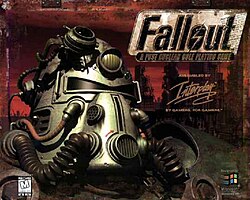
Fallout: A Post Nuclear Role Playing Game DEVELOPER: Interplay RELEASE DATE: October 10, 1997 COMPLETION TIME: 22 hours RATING: A |
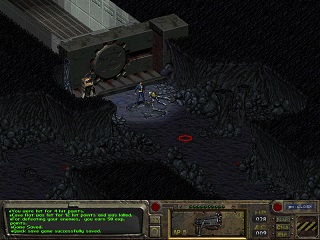 Introduction - Fallout is an isometric turn-based post apocalyptic role-playing game developed and published by Interplay in 1997. You take control of a single character which you can create yourself or choose among a list of pre-made character options. Throughout the game you'll traverse the vast wasteland of the western region of the United States.
You will talk to various different NPCs, engage in many fights with the turn-based combat system, and utilize your character skills to solve quests and to get yourself out of different situations.
Introduction - Fallout is an isometric turn-based post apocalyptic role-playing game developed and published by Interplay in 1997. You take control of a single character which you can create yourself or choose among a list of pre-made character options. Throughout the game you'll traverse the vast wasteland of the western region of the United States.
You will talk to various different NPCs, engage in many fights with the turn-based combat system, and utilize your character skills to solve quests and to get yourself out of different situations.
Fallout had an interesting development; it was created as a spiritual successor to the 1988 post-apocalyptic RPG, Wasteland. It couldn't be called Wasteland 2 however, since Electronic Arts owned the license. So the project started as a GURPS RPG under the name of Vault 13. Most of Fallout's development was using the GURPS system. If you don't know about GURPS, it stands for Generic Universal Role Playing System, and is a system of core rules designed to work with any game setting. GURPS was an advanced and adaptive system that was different from other RPG systems of the time. It allowed for player advantages and disadvantages as well as skills and perks. Eventually, however, late in development they had to remove the GURPS system from the game due to losing the license. So in only 2 weeks, just a few months before the game shipped, the rules system of Fallout was overhauled and rewritten into a new system, which became known as SPECIAL. This system took inspiration from GURPS while simplifying certain aspects such as combining advantages and disadvantages into a single component called traits and creating unique perks that fit the world and style.
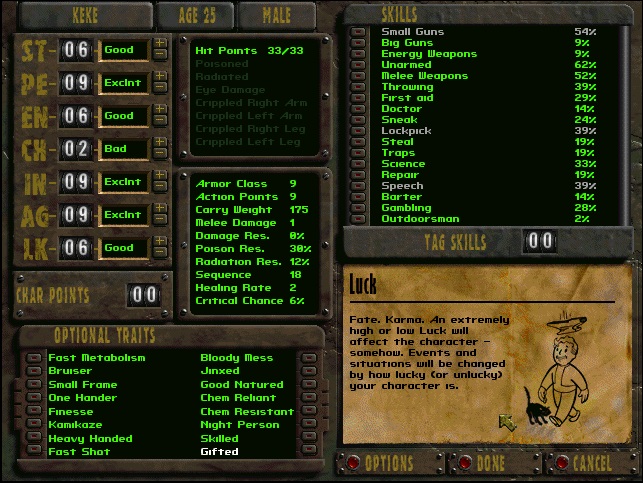
S.P.E.C.I.A.L Systems and MechanicsThe SPECIAL system consists of 7 attributes with values ranging from 1 - 10, various skills with values ranging from 1 - 100, traits that the player can optionally pick upon character creation that provide interesting advantages and disadvantages, and perks which are earned every 3rd level and provide various advantages. The role-play mechanics work well and are well designed. However, the way they are implemented in the game, varies in quality and usefulness. They, for the most part, do a good job at offering the player with many different role-play options throughout the game and in the many quests. Your skills can be used to solve different problems such as speech to talk your way out of a situation, repair to fix some old machinery, science to hack open force field doors, lockpicking to open locked doors or containers, and so on. Your attributes also help in certain scenarios. Most are useful for combat related situations, however there are a few attribute checks during dialogue, such as an intelligence check at the very end of the game.
 |
|---|
| Character Sheet (click for larger version) |
While there are quite a few useful skills and attributes, there are also a lot of worthless ones too. For example, charisma is an infamous dump stat in this game because its only use is to help with the bartering skill which is also a pretty useless skill. Money isn't really a problem for most of the game and you'll also find most of your gear out in the field, so money is only really spent for ammo or stimpacks occasionally. So charisma ends up being pointless. Another attribute that while is not pointless, is not as high priority is strength. If you're not playing a melee build, then strength is only useful for carrying weight. However, once you get power armor about midway through the game, it increases your strength by 4 points. So if you want max strength then you only need to put 6 points into it at the beginning. Even less if you don't care to max it. Then there's the skills. There are a lot of skills, and unless you have a very specific type of character in mind, most of them are useless. First of all you have your weapon skills; small guns, big guns, energy weapons, unarmed, melee weapons, and throwing. Now if you're going for a melee build then obviously either unarmed or melee are your options. For gun skills, it's a little more complicated. You have these 3 main weapon types, but you'll mostly find weapons that fall under the small guns category, especially in the early game. So if you invest in big guns or energy, then your going to be pretty screwed for most of the game until you come across a weapon that fits your skill. So you'll probably have to invest some points into small guns early on just so you can survive and actually kill something. That ends up costing you a lot of skill points since untagged skills require more points to increase. So what ends up happening is most players will pick either small guns or one of the melee options for their character so they can actually use the weapons they find properly and to make the game easier. But then they miss out on the cool big guns and energy weapons that you find in the late game. This is a problem that the sequel suffers from too and can be difficult to solve depending on how you balance your game. Since these types of weapons are so powerful, they have to be late game items, otherwise the game would be too easy. Anyways, I don't want to ramble on about this subject forever but you get my point.
Moving on, you also have many, less useful, non combat skills as well. Such as doctor, steal, traps, barter, gambling, and outdoorsman. These skills can be useful in a few rare occasions or have benefits that are so minor, and thus, are not worth putting points into more often than not. Since the player can only tag 3 skills, 4 if they get a perk, they are unlikely to utilize much of these skills unless they are role-playing a certain way and aren't worried about being an effective or efficient character. Now, I'm not trying to argue that an efficient character is the only way to properly play an RPG, but if you're going to implement a vast amount of skills, then they need to be useful for something at least semi-regularly through the campaign. Having a lot of skills adds a lot of choices for character creation which is nice and I don't mind them, but I wish that Fallout utilized some of these better. Certain skills such as speech, lockpick, repair, and science are used much more throughout the game and end up being the most commonly used skills for most playthroughs, which lessens the replayability. Fallout isn't the only game guilty of this however, many other RPGs have this problem, some more than others. However this is something that I had to point out because Fallout is not a perfect game or a perfect RPG. I still love it though but I'm not blind to its faults.
CombatThe combat is turn-based and uses a point based economy. You have a set amount of action points per turn and every action you make cost points. This includes attacking, moving, throwing, using items like stimpacks, and opening your inventory. Your total action points are tied to your agility attribute and ranges from 1 to 10. Agility is pretty dang important for combat, as you can see. This then leads to agility being arguably the most important attribute in the game. If your agility is high enough, you could potentially be able to perform 2 or 3 attacks in one turn, which would give you a huge advantage over your enemies. This makes agility crucial for any build unless you're doing a non-combat playthrough which I'm not sure if that's entirely possible. Going back to combat, you're given an option to do a normal attack and an aimed shot. Normal attacks will hit the body with the highest chance to hit but do a regular amount of damage. Aimed shots allow you to aim for specific body parts with varying chances to hit for different effects. You can aim for the eyes for the highest damage, or arms to decrease their aim, or their legs to lower their movement distance. The precision shots offer more options to make what is otherwise a pretty simple combat system a bit more interesting. I also want to note that this game gets really violent too. Getting kills with different weapons provides different kill animations which are really gory and also really satisfying. Finishing off a super mutant with a combat shotgun, for example, will blast half their body apart with blood splattering everywhere. It really helps make the combat even more fun and exciting, if you're into that. Also a note on critical hits:
 |
|
 |
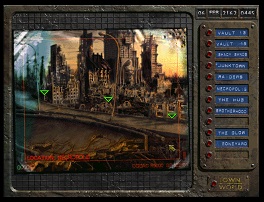 The setting of Fallout is on the west coast of the United States, nearly a century after the global nuclear war between the U.S and China. You start the game in one of the many vaults which were created to protect citizens from the nuclear bombs. Vault 13, the vault you live in, is where the game begins. Vault 13 is positioned at the northern end of the map. Which spans all the way down past the Boneyard which represents what's left of Los Angeles. Past that is The Glow which is an old research facility that was nuked directly during the war.
What's left is a large crater that leads to a surprisingly intact interior full of radiation, mutant creatures, and killer robots. Throughout the rest of the world map you have a vast and mostly empty desert with some locations scattered around such as the small farming village of Shady Sands, the large bustling city called the Hub, the protected military base of the Brotherhood of Steel, the radiated and shabby town of ghouls, and so on.
The setting of Fallout is on the west coast of the United States, nearly a century after the global nuclear war between the U.S and China. You start the game in one of the many vaults which were created to protect citizens from the nuclear bombs. Vault 13, the vault you live in, is where the game begins. Vault 13 is positioned at the northern end of the map. Which spans all the way down past the Boneyard which represents what's left of Los Angeles. Past that is The Glow which is an old research facility that was nuked directly during the war.
What's left is a large crater that leads to a surprisingly intact interior full of radiation, mutant creatures, and killer robots. Throughout the rest of the world map you have a vast and mostly empty desert with some locations scattered around such as the small farming village of Shady Sands, the large bustling city called the Hub, the protected military base of the Brotherhood of Steel, the radiated and shabby town of ghouls, and so on.
When you venture into the wasteland in the world map, you have the option of traveling to any locations that you either already visited or known the location of by obtaining the directions from somewhere. You are also free to explore in any direction you want and hope you come across a location along the way. Be careful however, when traveling the world map. Every time you pass one grid space, there's a chance of a random encounter. These can be either combat encounters or lone traders or other interesting little finds. Also, depending on where you're traveling, you will encounter different types of enemies. Some of which can be very high level which helps stop low level players from entering certain high level areas.
Companion SystemThough Fallout is primarily a single character RPG, there are companions or followers that you can recruit. There is a limited selection of these followers and they aren't necessary for progression but they can help out a bit, especially if your character is not very combat focused. The followers will follow you and help in any combat scenarios. You don't however have any control of their actions. Not even to give some basic commands like retreat or switch weapons or anything. Even sorting their inventory or trading items is more trouble than it should be. Their inventory screen just acts as normal bartering, so to give them an item you have to trade it to them. If you want something from their inventory, then you have to actually buy it from them with caps or trading an item. It's clear that there wasn't much time or effort put into the follower mechanics in Fallout. It really just seems like a last minute addition unfortunately. The sequel, however, greatly expands on the follower mechanics and allows for much greater control over you followers thankfully.
 |
|---|
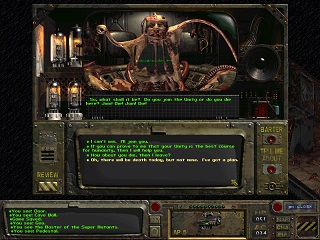
| "So what shall it be? Do you join the Unity or do you die here? Join! Die! Join! Die!" - The Master |
The story follows a member of Vault 13 who has been sent on a mission to obtain a new water chip for the Vault. Their current water chip has malfunctioned, and if they don't get a new one in 150 days, then it means the end for everyone in the vault. You, the player, are the lucky chosen one that must venture into the wasteland and find a new water chip for your vault. You've lived in this vault all of your life, and no nothing about the outside world. You will explore the unforgiving wasteland for the first time, witness how others live, meet friends and enemies, and fight for survival as you search for this water chip. Normally I'm not a fan of time limits in games, however this time limit makes sense for the story and also is very generous. 150 days is more than enough time to explore most of the locations in the game world and take your time as you narrow your search to the water chip location. Once you obtain and deliver this water chip back to your vault, there are no more time limits, in the current version of the game anyway. There was an additional time limit in the original version for your next quest, stopping the super mutants. Originally you had 500 days to complete this quest, however this was removed in later versions. While I don't think this extra time limit would have hurt the experience much, if at all, I still am glad it was patched out, since I like knowing I have as much time as I want to wander around and take my time in an RPG. Moving on, after you have returned the water chip and made your report on your experience, the overseer asks you to find the source of the super mutants and stop them. These super mutants are reproducing at an alarming rate. The most logical explanation is that there is a lab somewhere creating these creatures. Your goal for the rest of the story is to find where and how they are being created and put a stop to it.
From this point in the story, you will meet the two main factions, The Brotherhood of Steel and The Children of The Cathedral. The Brotherhood of Steel is a military organization founded by the United States government. They own a protected underground base in the western region of California. Their goal is to acquire new technologies and to stop the army of super mutants that are spreading across the wasteland. You don't need to join the Brotherhood to complete your mission, but they have useful equipment and intelligence that can help. For example, if you talk to the head scribe, Veer, you can acquire documentation on some crucially important information on the super mutants which can be used to your advantage.
As you're exploring the wasteland, you may have come across some robed figures around. If you talk to them, they will tell you about The Children of The Cathedral. This cult of worshipers and priests, serve The Master and follow his plan for unity. The Master is the leader of the super mutants and the children. His great plan is to forcibly inject humans with FEV, which is the virus that's used to create super mutants. Turning everyone into super mutants would unify the human race and ensure everyone is safe from radiation. The problem is FEV has many side effects such as severely diminished intelligence, deformities, and one other that's particularly problematic which the master is unaware of, infertility. You cannot join the Children, but you must infiltrate their ranks and penetrate deep inside their base in order to reach the master and stop the creation of super mutants.
Conclusion - Fallout is an exceptional RPG that while being rather short in length for the genre, manages to pack in rich and interesting lore, unique characters, with great writing, music, and progression system. The length is actually perfect in my opinion. It doesn't need to be any longer and it doesn't feel like any content was cut. Fallout also doesn't bombard the player with side quests or other optional activities. It has a decent amount that all feel worthwhile to complete and help flesh out the world. Fallout also does a great job at easing the player into the game. The difficulty curve is very gradual, and you have plenty of time to explore and take in the world without being attacked constantly. Unlike in the sequel, which bumps up the difficulty quite a bit. Overall Fallout is a fantastic RPG that is much less bloated than many other RPGs while having quality writing, lore, and combat. The progression system, while unique, isn't used as well through the game as it could be, with many skills being under used. The companion system is also very lacking and feels more like a last minute addition. These problems hardly detract from the experience however. Fallout is still absolutely a quality game and RPG.
|
Grillsen Recommends: One of the greatest RPGs ever created in my opinion. Fallout is packed with rich lore, quality writing, and meaningful content with out any of the extra bloat or padding that many other RPGs suffer from. Fallout is an unforgetable experience that every RPG fan needs to play. |
| Pros | Cons |
|---|---|
|
|
|


Gridback background is created by me
Interplay and Fallout gif rights go to Interplay and their owners